


On September 26th, 2024, Helene made landfall near Perry, in the Big Bend region of Florida, as a category 4 hurricane, ravaging through six states, as North as Virginia and becoming the second deadliest hurricane to make landfall in mainland US in 50 years behind Katrina with a provisional (and still rising) death toll of 225+ and preliminary estimated damages of USD +30 billions to maybe North of USD 200 billions.
In its path of destruction, described as “biblical” by several media outlets covering the catastrophic damages Helene created, lie a number of lessons to be learned and parallels to be drawn, to explain and illustrate how climate change is shaping the future of humanity and how we should adapt, as a species, in a world of unhinged weather and climate.
Helene: a storm from a different kind
Helene is described as a “different” kind of storm. Stronger, wider, with many records broken in its path. It is important to understand how and why this storm came to be and all the ingredients leading to such destruction.
Potential tropical cyclone “Nine” was identified in the Western Caribbean sea on September 23rd, and the next day, became the named tropical storm Helene. 24 hours later exactly, at 11:00 AM EST on September 25th, Helene was declared a hurricane which intensified to a category 4 (on a scale of 5) in less than 32 hours while travelling through the Gulf of Mexico, before it made landfall in Florida, still intensifying with sustained winds at 220 Km/h (140 mph).

The speed at which Helene intensified has surprised scientists, originally expecting the hurricane to make landfall at a category 3 maximum. In addition, the massive size of the storm has contributed to its expansive impacts, with 420 miles of width, making it the third biggest storm to landfall in the Gulf of Mexico.

Helene was the eight named storm of the hurricane season 2024. Since then, (less than two weeks), five more storms have been named, four of which becoming hurricanes – hurricane Isaac (Cat 2), tropical storm Joyce, hurricane Kirk (Cat 4), hurricane Leslie (Cat 1), hurricane Milton (currently a Cat 1 and threatening to landfall in Tampa Bay, Florida by Wednesday October 9th, 2024 as a Cat 3). This long list makes the hurricane season 2024 above average in terms of named storms, despite a slow start. In addition, both Kirk and Leslie have broken consecutively the record of farthest East formed hurricane in the Tropics at such a late date.

To form and develop, tropical storms and hurricanes require warm ocean water to fuel them and sustain them. This video explains the process clearly. The warmer the water is and the more the storm will feed itself and strengthen, which leads us to climate change.
The ingredients to create Helene – A climate-change fueled recipe
To create monsters like Helene, Kirk, Beryl or Milton, we need warm water. With climate change, we are getting plenty. Bare with me while I try to explain the link between climate change and hot ocean water. Also, I am simplifying so please accept my apologies for the shortcuts I make.
The sun, through its radiations, is sending energy to planet earth, of which a great part is being trapped in our atmosphere through greenhouse effect (which is by the way what makes our planet livable). Additional greenhouse effect, created by human activities, and especially burning of fossil fuels, leads to more of this energy remaining trapped in our atmosphere, creating positive radiative forcing.
Radiative forcing is a key concept to understand climate change: it describes the balance between the energy Earth receives from the sun and the energy it radiates back into space. When more energy is trapped than released – as it happens from increased greenhouse gases concentration – the radiative forcing is positive; heat accumulates and the planet warms. This imbalance (existing today and amplifying) causes effects like higher ocean temperatures, leading to stronger hurricanes. Simply put, it’s the “extra heat” Earth holds due to human activity, making our climate warmer and more extreme.
Oceans are playing a key role in trying to mitigate both additional greenhouse effect and to reduce radiative forcing. As a carbon sink, oceans absorb 25% of the additional CO2 emitted each year, leading to ocean acidification and water warming and they also absorb 90% of the energy accumulated on earth due to radiative forcing, which also contributes to heating ocean waters, melting ice and contributing to the rise of ocean waters (water expands as it warms).
These two characteristics explain why ocean waters are warming at an alarming rate and breaking records regularly, leading to the development of more hurricanes, that intensify faster and create bigger impacts with bigger storm surges.

Additional preliminary studies show other impacts climate change has on cyclones and Helene:
- One affirms that cyclones similar to Helene are made 20% wetter in the south east US and 7 % windier in Florida’s gulf than in the past;
- Another one explains that climate change might have increased rainfalls from Helene by 50% over Georgia and the Carolinas.
Helene, breaking records one state at a time
Helene, in numbers, is mind boggling: more than 40 trillions gallons of rain dropped on the Southeastern US, 2 million people losing power (and 250,000 still without it a week after), and damages expected to last for months if not years, but by States, the records are even more daunting.
FLORIDA
Labelled as the biggest storm to ever hit the Big Bend of Florida, Helene advisories from the Hurricane Centre warned of “unsurvivable” storm surges of up to 20 feet. Storm surges as explained in this video, are formed as the hurricane pushes the water on land. They are amplified by higher ocean waters, that have risen more than 20cm since 1880 with human induced climate change. Storm surges are usually the deadliest and most destructive part of hurricanes.
Cedar Key’s storm surge reached an unprecedented 9.3 feet, breaking Idalia’s record by 2 feet, engulfing homes and flooding streets. The Big Bend region was even more devastated, with water levels pushing 15 feet, a deadly reminder of how unpredictable nature’s wrath can be.” In total, 20 people perished in the State.
Helene might finally have been the storm making Floridians finally starting to rethink their living location and take warning more seriously, but we will talk about it later. Right now, (as of October 7th 2024) most of them are busy prepping for yet another incoming major hurricane, Milton, predicted to hit somewhere in the Tampa Bay as a minimum category 3 hurricane (but already a Cat 4 on Monday October 7th at 10:00 AM EST, and going through the fastest intensification ever seen in the Atlantic, at now 2 mph from becoming a Cat 5 , actually now declared a Cat 5, at 1:00 PM EST on October 7th!) and have devastating impacts as the Florida Coast is still full of debris (potential projectiles) and evacuation efforts are hampered by the state of the roads damaged from Helene and the loss of vehicles from this storm.
GEORGIA
Helene barreled into Georgia as a category 2 hurricane, after two already really rainy days and created flash floods throughout the State. 33 people died. Atlanta broke its 48 hours rainfall record with 11.3 inches of rain, while Augusta recorded 12 to 15 inches of rain, amounting to 4 months of precipitation in two days.
VIRGINIA
In Virginia, the impacts from Helene caused 2 deaths and massive flooding. Preliminary estimates indicate that Helene created USD 125 million in damage to the agricultural sector.

NORTH CAROLINA, SOUTH CAROLINA & TENNESSEE
The Appalachian Mountains were the most affected by Helene with torrential downpours coming to an already water saturated region. 12 people perished in Tennessee, 48 in South Carolina, and 117 in North Carolina, with hundreds still missing.
In this worst case scenario, Helene rolled into an already humid area and dropped more than 2 feet of rain in the mountains, saturating reservoirs and rivers. Contrary to what has been said initially, it looks like Helene did not go through Fujiwhara effect per say. The Fujiwhara effect is a rare meteorological event in which two low pressure systems turn around each other to finally merge together, bringing additional rainfall to the area.
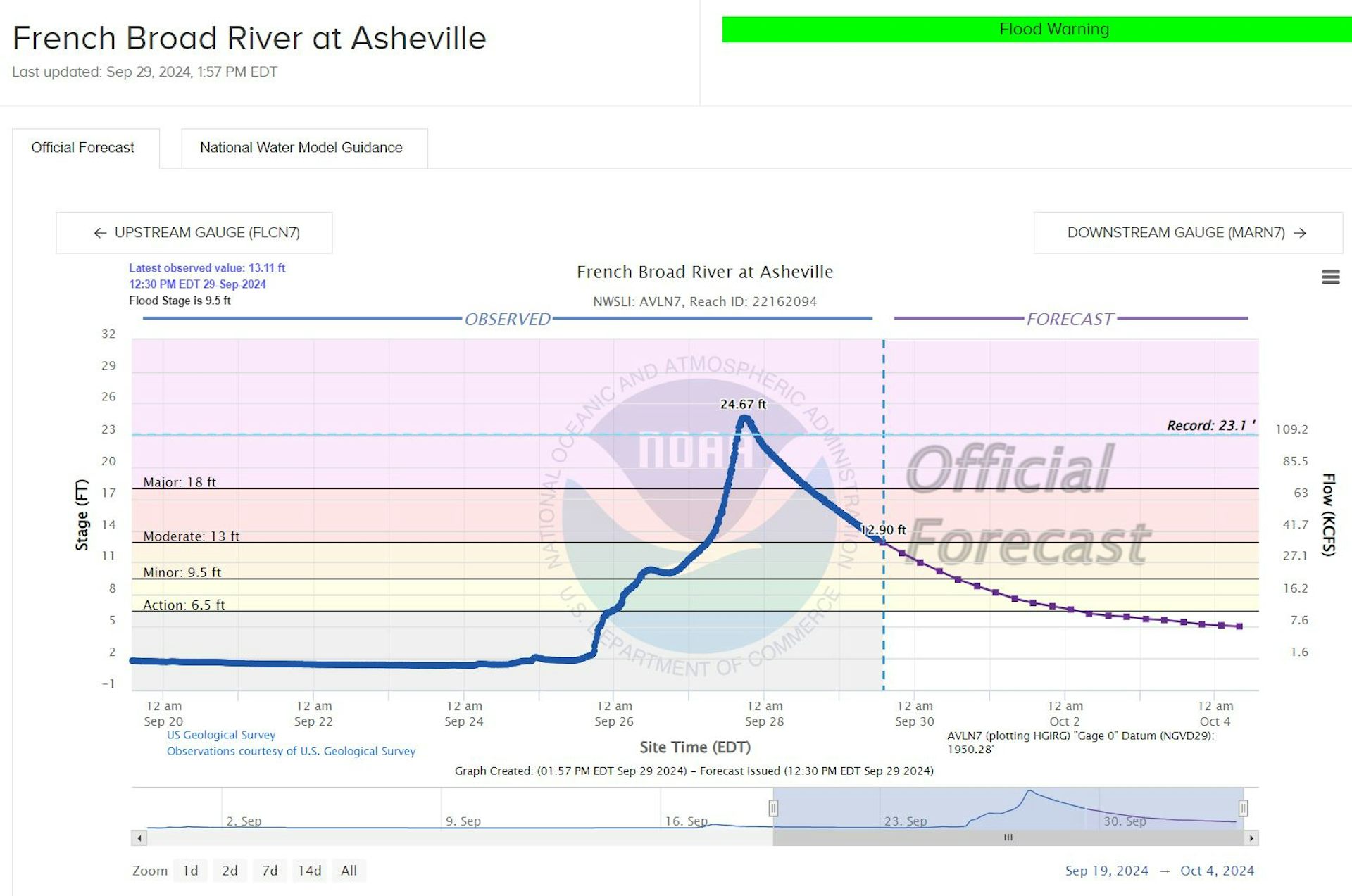
Aggravating factor or not, rainfall numbers are unfathomable; the National Weather Service reported between 8 to 22 inches across South Carolina, more than 30 inches in some places in North Carolina. The French Broad River crested at 24.67 feet in Asheville, beating from more than 2 feet the previous record, standing for more than a century.
There are no words to describe the level of destruction in these areas, with houses washing away, roads completely destroyed and thousands of trees down. Towns, such as Chimney Rock, leveled by the rushing waters and debris. Despite warnings, not all had the luxury to leave, or had the opportunity or understood really the magnitude of what Helene would be.
The aftermath of Helene – how a climate disaster has the potential to influence the worldwide scene
After describing the physical impacts of Helene, let’s dive into the repercurssions and rippling effects this storm will potentially have in the US and beyond. When climate change shapes the future of humanity, directly and indirectly.
AN US GENERAL ELECTION WEEKS AWAY – A FIELD DAY FOR MISINFORMATION
Helene swept through the Southeastern US less than six weeks before what might be the most important general election for the United States in recent history. Through its path, it created havoc in two important swing States: Georgia and North Carolina, potentially changing the results. Elections officials are busy trying to ensure that one fifth of North Carolina voters, located in areas battered by Helene, will be able to vote.
Meanwhile, a lot of disinformation is going around and influencing the narrative around the response to Helene and the impact the Federal government had on the storm. Social media, and especially X (former twitter), the platform once being a solid source of information and support during disasters has now been turned, by its billionaire owner, into a cesspool of misinformation and fake news, even pushed by Musk himself.
In the case of Helene, disinformation has been pushed allover, including by Trump, candidate to the US Presidency, regarding the Federal response to the disaster. Between conspiracy theories around withholding aid, or purposely redirecting the hurricane with geo-engineering, a lot has been making its way in the mind of Americans and especially victims, trying to find support from the disaster. To the point where local newspapers have taken on themselves to call out rumors in editorials, and FEMA (Federal Emergency Management Agency) put out a release to try and end rumors.

Despite all the efforts put out to limit disinformation, the Government is struggling to quash the rumors, hampering recovery efforts. Especially when some of the conspiracy theories are based on actual facts teaching people a thing or two about the areas affected…
DISRUPTION TO GLOBAL SUPPLY CHAINS, FROM CLOTHING TO MICROCHIPS
Yup. Conspiracy theories are right about at least one thing: Helene will disrupt global supply chains and possibly create shortages in various sectors. Unknown by many before the disaster, it turns out that a small region of North Carolina is the sole producer of a very pure quartz, used in the production of semiconductors used for computers, artificial intelligence and more. The two mines, operated by Sibelco, are located in Spruce Pine, ravaged by Helene, threatening a USD 600 billion worldwide industry, despite minimal damage on the site itself.
In addition to this blatant example, other sectors are severely impacted, such as agriculture. Helene’s damages are preliminary estimated at USD 1 billion in production loss, with Georgia being the most impacted. Cotton producers are reporting 35% to total yield loss and worries are mounting regarding peanut harvest, Georgia producing 42% of the total US yield. The poultry industry has also been devastatingly hit, with at least 107 operations damaged or destroyed, including the 3rd poultry producer in the nation, Wayne-Sanderson Farms obliged to close a plant in Moultrie processing 1.3 million chickens weekly.
RESHAPING WHERE PEOPLE LIVE AND THE QUESTION OF CLIMATE REFUGEES
Throughout its path of biblical destruction, the question is raised: are people going back to live in such altered landscapes, now aware of the risks of a new realised climate reality?
Floridians are known for their resilience and their pathological (I use the term with the most utmost respect and affection, not in a derogatory way) pride to weather powerful storms but some of them have seen (before upcoming Milton) their houses flooded four times in less than a year and a half.
Most home-owners in the community of Shore Acres, in Saint Petersburg, Florida, hit by a record storm surge from Helene, are ready to sell after one too many storm. Insurance prices (or lack of) and multiple efforts to rebuild lead people away from the area. At a larger scale, damages from Helene lead 32% of young Americans (18 to 34 years old) to rethink where they want to live.
The question of insurance also comes into play. In Florida, prices are becoming unrealistic and despite efforts to stabilize them, uncertainty remains. In North Carolina, most survivors do not have flood insurance and will struggle to get compensated for damages. Throughout Georgia and the Carolinas, only 2% of households in flooded areas are eligible to insurance payments.
The gap in insurance coverage can be explained by several factors: first, the fragmented way disasters are covered and inconsistencies in the coverage required, between outdated data and greedy insurance. Most North Carolinians never thought they’d ever need any kind of flood insurance, especially in the mountains. Finally, price of insurance is becoming prohibitive or not available, in particular in Florida, where disasters are frequent.
All these factors will considerably shape the future of the US and where people live. Some conspiracy theories have even developed around these circumstances, arguing that Helene was a land grab for mining, Piedmont Mining being in the process of permitting some lithium mines in North Carolina to produce EV batteries for Tesla. If this wasn’t a conspiracy, it is undeniable that Helene will make it easier for mining companies to access the area in the future, some victims likely desperate to recover some loss from the storm.
Here is the billion dollars question and the one that might set a precedent worldwide: are victims of Helene, climate refugees?
That is a question I wouldn’t want to try and answer. The implications are so immense that I do not know how deep the rabbit hole would go. For instance, areas like Shore Acres are flooding several times a month, storm or not. Are they deemed uninhabitable or should locals continue to rebuild with higher and higher stilts? And if these areas are deemed uninhabitable due to climate change, what are the modalities (if any) of compensation and resettlement and who will pay for it?
This climate advocate, Helene survivor, who recently relocated from California to Asheville, NC gives his perspective, as a self-proclaimed climate refugee. This other climate advocate, born in Asheville, NC and now living in California provides her perspective on seeing her birth town being hit so hard and the disilusionment of “false climate hope”.
What to learn from Helene
The impacts of Helene will be long lasting for the affected areas, the US as a whole and the world, as recovery slowly progresses. I wish to say that Helene’s records will also be long lasting but the next Atlantic hurricane, Milton, now the strongest since Rita (2005) with winds up to 180 mph, is likely to shatter those in a few days.
Welcome to what I like to call, the radically unhinged era. Here are some important lessons to learn from Helene and other recent disasters:
– Nowhere is safe from climate change. Helene showed how inland impacts can be felt and how devastating it can be. Once climate disaster hit, all the money in the world cannot help, when surviving becomes a challenge;
– Unprecedented and biblical impacts are the new normal. Climate change will make disasters more unpredictable and more violent. Our infrastructures and societies are not ready to face what is coming;
– Living near water is unsafe: shore erosion, flooding, rising water level, flood plains, all these areas should be seriously reassessed and reconsidered when building. Learn where your property is and what are the biggest risks you can face;
– Prepare for the worst and build resilience systems that might not look like what you think. North Carolina and Tennessee are amongst the best deemed States for preppers and yet, communities were wiped by Helene. Having knit tight and close neighborhoods helped with immediate first response and support. Goats and mules were instrumental in getting supplies to damaged areas as roads were destroyed. Make sure you have all you need for surviving through disaster and that you have a solid and tested evacuation plan.
– Review your insurance policy and know what you are covered for. Helene showed the limitations of the US insurance system. In Canada and Ontario, insurers have removed the flood protection from some policies, without necessarily explicitly warning home owners.
Climate disasters will continue to happen and amplify in various shape, form and size as our planet continue to warm due to human induced greenhouse effect and climate change and as we progressively reach tipping points of planetary boundaries. In this era of “radically unhinged”, it is time for us to radically change the way we see our future on this planet and how we operate. Banning fossil fuels is the bare minimum we should do to limit global warming. Beyond that, every decimal of warming avoided is that much of a better chance we have to fare better through this crisis. As it stands though, I do not have much hope that we will avoid the worst… And the IPCC starts thinking the same. A silver lining though seems to be the impact Helene has had on Americans and the way maybe it will shift the narrative regarding all these questions and climate change in general. Observers declare that they already see a massive difference in the way Tampa Bay locals are preparing for hurricane Milton.


0 Comments